

Execution Over Rhetoric: The Limits of Performance Politics
Who’s fighting for you when the cameras are off?
by, Tyler Letren.
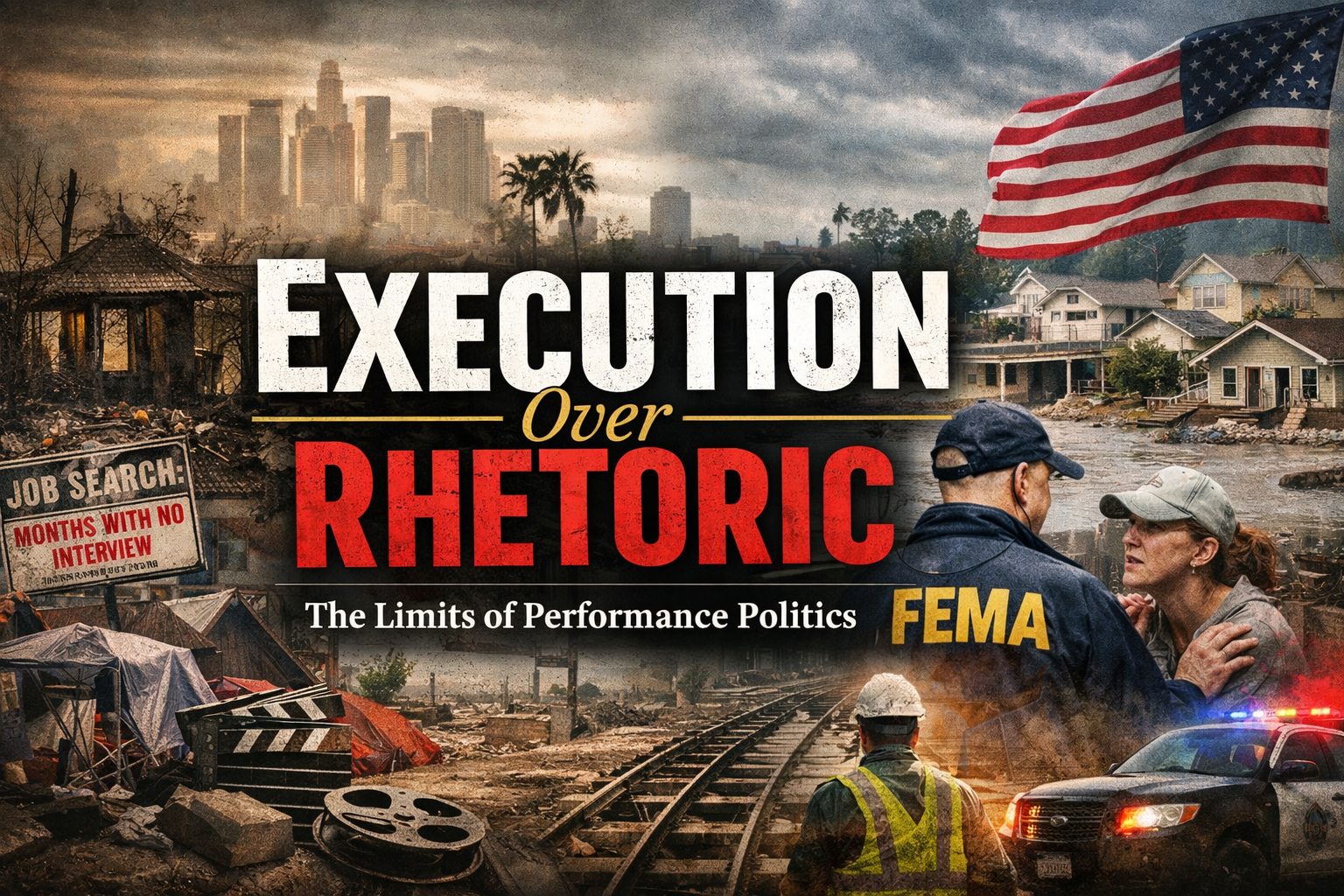
On the heels of California’s $23 million homelessness-funds fraud investigation—implicating figures such as Alexander Soofer and others charged with wire fraud for allegedly diverting taxpayer money intended to house and feed unhoused residents in Los Angeles—serious questions must be asked about governance, oversight, and political leadership in the United States.
I do not, in good faith, believe that the Democratic Party currently presents a suitable candidate for the presidency. There are capable individuals within its ranks, but many appear better positioned for state legislatures, municipal governance, regulatory agencies, or academic roles than for the executive responsibility of national office.
Three years remain. It is not a competition; it is a contest.
For the Democratic Party, this distinction is fundamental. A competition rewards message discipline, fundraising capacity, and coalition alignment. A contest evaluates outcomes: whether policy produces stability, whether institutions retain legitimacy under stress, and whether leadership appears primarily concerned with the material well-being of Americans themselves rather than symbolic positioning.
This is where Republican positioning has gained traction.
Public frustration surrounding immigration enforcement—particularly protests directed at U.S. Immigration and Customs Enforcement—has increasingly been framed by Republicans as evidence of misplaced priorities. When enforcement actions involving individuals accused of serious crimes are met with demonstrations demanding release, many voters do not interpret this as humanitarian advocacy. Instead, they see a political class more invested in ideological signaling than in public safety and order.
The Republican argument is not simply anti-immigration; it is hierarchical. Voters are told that a government unable or unwilling to enforce borders and removals cannot credibly claim to manage housing markets, labor systems, or public funds. In this framing, enforcement is not cruelty—it is prerequisite governance.
This contrast resonates most sharply in high-visibility states such as California.
Gavin Newsom has become a national proxy for this tension. His reputation is shaped not only by partisan opposition, but by California’s role as a policy stress test. The state’s homelessness crisis—spanning public and private shelters, paid and unpaid systems, and widespread encampments—is often mischaracterized as simple mismanagement. In reality, it is a crisis of scale and velocity: displacement is occurring faster than policy can absorb.
California’s instability feeds a broader Republican critique—that Democratic governance struggles when enforcement, accountability, and magnitude converge.
This vulnerability is also visible within the Democratic Party’s emerging bench.
Several Democratic hopefuls have risen through media traction rather than demonstrated durability under sustained scrutiny. A prominent example is Tim Walz, who gained national attention in early 2024 following widely circulated remarks characterizing Trump-aligned figures and Project 2025 as “weird.” The comments resonated on social media, elevating Walz into vice-presidential conversations and broader national consideration.
That visibility also invited scrutiny.
Following Trump’s return to office, Republican opposition research and congressional attention turned toward Minnesota governance, including large-scale fraud cases involving federally funded childcare and social-service programs—often referenced in public discourse as Somali daycare– or Feeding Our Future–related investigations. While these cases primarily implicated nonprofit operators and contractors rather than elected officials, their scope raised questions about administrative oversight and enforcement failures.
The political fallout was swift. Minneapolis Mayor Jacob Frey was thrust back into the national spotlight, holding multiple press conferences defending his city, its governance structures, and the distinction between criminal actors and the broader community. Regardless of legal outcomes, the optics proved damaging.
Against this backdrop, Walz’s decision not to pursue reelection has fueled questions about his future in electoral politics. While not an admission of wrongdoing, the decision underscores a recurring Democratic vulnerability: figures elevated through rhetorical moments often struggle once governance records are reframed through enforcement, accountability, and institutional control.
Republicans have capitalized on this pattern.
The strategy extends beyond policy into political symbolism. Within GOP circles, there is a growing—and closely scrutinized—willingness to explore the political rehabilitation of figures associated with grievance politics. This includes discussions around pardoned January 6 participants and, potentially, the public positioning of figures such as Kyle Rittenhouse. While not formal candidacies, these gestures reflect a broader strategic calculation: that segments of the electorate alienated from institutional authority respond to candidates and symbols that openly challenge prosecutorial legitimacy, elite consensus, and media narratives.
Whether this approach matures into viable officeholders or remains symbolic signaling remains unresolved.
At the same time, Democrats are losing ground where they once held near-automatic alignment: the technology sector.
For decades, Democratic leadership benefited from deep loyalty among tech founders, CEOs, and venture capital. That alignment is now eroding—not primarily over social issues, but over execution. Technology leaders are systems thinkers. They expect scalability, timelines, and measurable progress. What many increasingly observe in Democratic-led states is heavy rhetoric paired with underinvestment in durable solutions.
Housing, infrastructure, energy permitting, homelessness, and public safety are viewed by founders not as moral abstractions, but as solvable engineering and governance problems. When those problems persist year after year—despite record spending—confidence erodes.
This erosion is reinforced by moments of symbolic distance. Vice President Kamala Harris has publicly recounted an instance in which President Joe Biden declined to invite Elon Musk to a White House event intended to honor technological advancement. While casually framed, the episode carried weight within the tech community.
To founders and executives, the issue was not personality or politics. Musk represents large-scale execution—manufacturing at volume, infrastructure deployment, supply-chain compression, and rapid iteration under constraint. Excluding figures associated with that level of delivery, even symbolically, reinforced a perception that Democratic leadership struggles to separate ideological comfort from operational necessity.
In a competition, symbolism can be dismissed.
In a contest, it compounds.
Republicans have recognized this opening. While not traditionally viewed as tech-friendly, the GOP has repositioned around execution: regulatory clarity, enforcement consistency, speed of permitting, and return on investment. Founders relocating to Republican-led states cite predictability, lower friction, and clearer authority—not cultural alignment.
As tech leaders exit Democratic jurisdictions, the loss is not only capital and jobs, but competence. The party is losing the very builders capable of designing scalable solutions—accelerating the divide it struggles to close.
This erosion of confidence is not limited to abstract governance debates; it is reinforced by a series of visible failures that critics increasingly attribute to Democratic stewardship in key states.
In California, Democratic leadership is frequently lambasted for presiding over the steady exit of the entertainment industry. Film and television production—once structurally anchored to Los Angeles—has increasingly migrated to states offering lower costs, tax certainty, and fewer regulatory delays. Critics argue that California’s response has been reactive rather than structural, relying on incentives that fail to address permitting delays, labor rigidity, and cost inflation.
Natural disasters have further tested institutional credibility. The North Carolina hurricane and routine seasonal hurricanes across the South—particularly in Florida—exposed a familiar pattern: federal visits, press conferences, and assurances, followed by prolonged recovery timelines. Many residents report that more than a year later, insurance claims remain unresolved, infrastructure repairs incomplete, and local economies still struggling to stabilize.
In California, the Pacific Palisades fire has become emblematic of these concerns. One year on, fewer than ten homes reportedly stand rebuilt, with empty lots dominating affected neighborhoods. Families continue to wait on insurance payouts, while others face pressure to sell to developers. Whether attributable to insurers, regulators, or zoning authorities, the outcome reinforces a perception of an administrative state unable to move with urgency during crisis.
Economic displacement compounds these pressures. Companies leaving California or shuttering locations have contributed to rising unemployment in already strained labor markets. In Los Angeles, job searches routinely stretch months without a single interview—clashing sharply with political narratives of economic resilience.
Infrastructure failures further erode confidence. California’s long-promised light-rail expansions—once heralded as climate-forward modernization—are now cited as symbols of institutional inertia: ambitious announcements followed by limited track laid, ballooning costs, and indefinite timelines.
Beyond California, similar critiques are leveled at other Democratic-led states. In Illinois, persistent violence in several predominantly Black and Brown cities has led critics to describe conditions as resembling war zones—not as rhetorical exaggeration, but as a reflection of sustained disorder and ineffective intervention.
High-profile violent crimes in Democratic-led cities have further sharpened this narrative. Cases such as the killing of Iryna, a young Ukrainian woman stabbed by a repeat violent offender, are cited as failures of prosecutorial discretion, bail reform, or supervision systems. Regardless of individual case complexity, these incidents amplify a broader argument: systems designed to prioritize reform have, at times, failed to contain known risks.
What ultimately sharpens this debate is policy reaction.
Republicans increasingly frame these failures through a blunt but resonant question: Who is fighting for you? In this framing, America First means Americans first—especially when homes are destroyed, jobs disappear, or safety erodes. Leadership is judged not by empathy alone, but by whether families are restored, communities rebuilt, and systems made functional.
For sitting Democrats, the challenge is no longer rebutting individual criticisms. It is restoring confidence that institutions can still deliver outcomes proportionate to promises.
For Republicans, the opening lies in persuading voters that governance must first secure order, safety, and executional credibility.
For voters increasingly focused on results rather than intent, this distinction is decisive.
This is not a competition of messaging.
It is a contest of legitimacy, competence, and consequence.